Old City Philadelphia Lofts: History, Design & Buying
May 21, 2026
May 21, 2026
Wondering why Old City lofts feel so different from a standard condo? In this part of Philadelphia, the appeal is not just exposed brick and tall ceilings. It is the way history, architecture, and modern living all show up in the same space. If you are considering a loft in Old City, understanding how these homes were built, how they live day to day, and what rules can affect future changes will help you buy with more confidence. Let’s dive in.
Old City is one of Philadelphia’s strongest examples of adaptive reuse. According to the Old City District, the neighborhood service area covers a 22-block district bounded by Florist Street, Walnut and Dock Streets, 6th Street, and Front Street, with about 8,000 residents living in historic townhouses, industrial loft apartments, and newer condominium properties.
That mix matters because Old City is not a neighborhood where loft living was added as a trend later on. The neighborhood sits inside Philadelphia’s historic core, where museums, galleries, dining, nightlife, and independent retail are part of everyday life. In other words, the built environment and the lifestyle are closely linked.
Much of Old City’s loft inventory began as 19th-century warehouse and light-industrial buildings. National Park Service material describes the district as one of the country’s major collections of cast-iron and industrial loft buildings, with most constructed between 1850 and 1890.
These buildings were typically four to five stories tall, with storefronts at street level and storage or manufacturing space above. Over time, many upper floors were converted to residential use. That history is a big reason Old City lofts often feel authentic rather than imitated.
Old City is not made up of one building style. Historic district documentation describes a wide range of architecture, including early industrial buildings alongside Georgian, Federal, Greek Revival, and Italianate structures.
For you as a buyer, that means one loft can feel dramatically different from another, even within a few blocks. Some homes lean heavily industrial, while others blend loft-like interiors with older architectural details and a more traditional exterior setting.
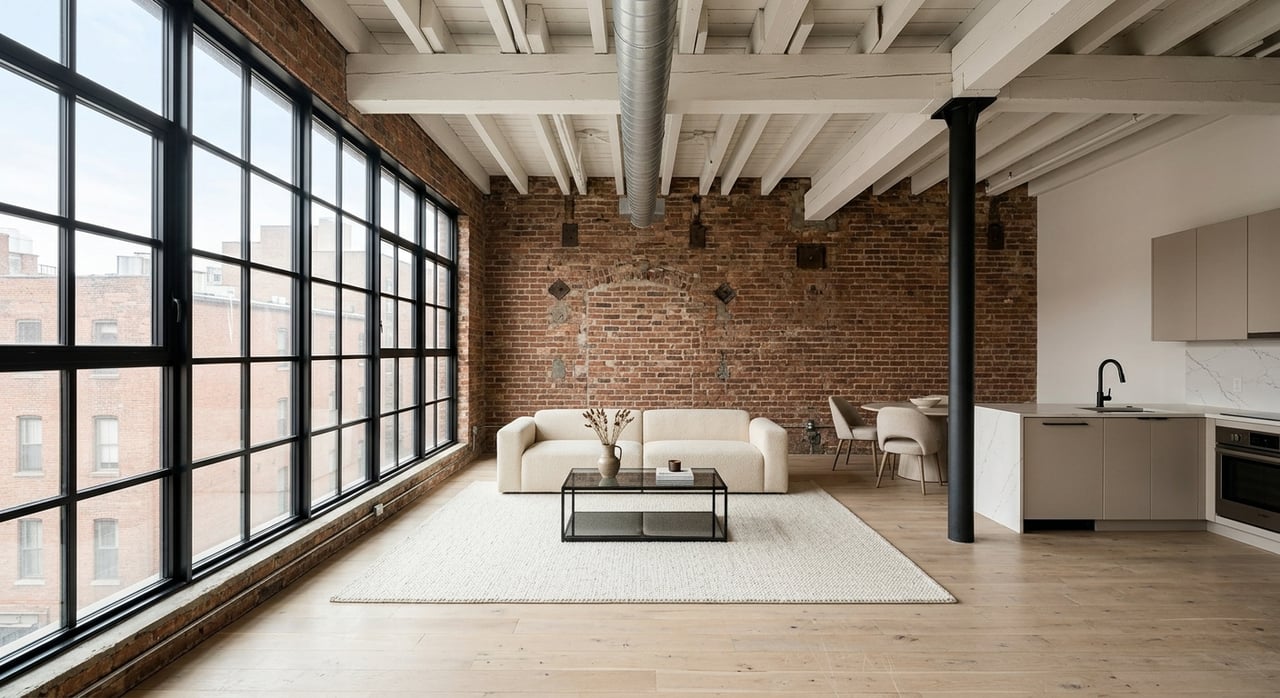
One reason buyers are drawn to Old City lofts is the sense of volume. Historic industrial buildings were designed for work and storage, not for small, divided rooms, so many converted units still feature open and flexible interiors.
National Park Service rehabilitation guidance identifies brick walls, exposed wood structural columns and ceilings, and unfinished industrial surfaces as important interior features that should generally be retained. Even when renovations add bedrooms and baths, those original elements often stay visible and continue to define the space.
A loft can look bright online and feel very different in person. In historic industrial buildings, daylight often enters strongest near the original window line, especially where buildings were designed with large window bays to bring light into work areas.
That means unit depth, orientation, and nearby buildings can have a real impact on how bright a home feels. If natural light is high on your list, it helps to look beyond finishes and pay attention to where the windows sit and how far light reaches into the interior.
Lofts can be visually soft and warm, but acoustically they may be a different story. Open volume, hard masonry, and exposed structural surfaces can allow sound to travel more easily than it might in a newer building with more partitioned rooms and more layered finishes.
This is not a district-wide noise finding, but it is a practical takeaway from the building form itself. When touring a loft, it is smart to notice window quality, floor buildup, inter-unit separation, and whether later renovations appear to include acoustic buffering.
The best Old City lofts balance preserved character with updated function. You may see original masonry paired with contemporary kitchens, modern baths, and cleaner partition layouts that make the space easier to live in without erasing what made the building special in the first place.
That balance is part of what makes Old City so compelling for design-conscious buyers. The neighborhood offers homes where industrial scale, historic materials, and modern finishes can coexist in a way that feels grounded in place rather than generic.
If a property is listed on the Philadelphia Register of Historic Places, changes require approval from the Philadelphia Historical Commission. The city says that review can cover construction, alterations, and demolition, including windows, roofing, masonry, storefront features, signage, and exterior mechanical equipment.
Interior changes are reviewed only when the interior itself is designated. Still, for many buyers, the biggest practical point is that visible exterior elements may not be as flexible as they would be in a typical non-historic property.
The Old City historic district manual makes the preservation approach clear. Regular maintenance is preferred to repair, repair is preferred to replacement, and replacement-in-kind or restoration to the original appearance is preferred to alteration.
In real life, that means historic components often carry real weight in renovation planning. If you are imagining new windows, exterior equipment changes, or alterations to visible features, it is important to understand the review process early.
If your loft is part of a condominium, there is another layer to consider. Under Pennsylvania law, the unit owners’ association is created when the first unit is conveyed, and the association may adopt and amend bylaws, rules, and regulations.
State law also says the association is generally responsible for maintenance, repair, and replacement of common elements unless the declaration says otherwise. In a loft building, that can affect anything tied to shared walls, roofs, facades, windows, or building systems.
Old City also has a Registered Community Organization process. The Old City District says it reviews zoning applications within its boundaries after filing with Licenses and Inspections.
For buyers thinking beyond cosmetic updates, that matters. Larger renovation or redevelopment plans may involve not only historic review, but also zoning and community review depending on the scope of the work.
Falling for the look is easy. Buying wisely takes a little more discipline.
The features that make Old City lofts memorable, like exposed masonry, original window openings, and open volumes, can also limit how easily a space can be reconfigured. Before you commit, it helps to get clear answers on both the home itself and the building rules around it.
Old City loft living is not just about aesthetics. It is about living in a part of Philadelphia where architecture, preservation, and neighborhood identity are tightly connected.
That is exactly why these homes continue to stand out. When you buy here, you are not simply choosing an open floor plan. You are choosing a home shaped by historic building form, adaptive reuse, and a daily environment that feels distinctively tied to Old City itself.
If you want help evaluating a loft in Old City with both design appeal and practical due diligence in mind, Evangeline Gambardella offers a thoughtful, data-driven approach that helps you see both the lifestyle value and the details behind the walls.
Stay up to date on the latest real estate trends.
Every client deserves to feel valued, heard, and supported. From our first conversation to the final handshake, my goal is to ensure your experience is as smooth and special as the moment. Your happiness isn’t just a priority—it’s the standard.

EVANGELINE GAMBARDELLA
728 S Broad St 3rd Fl Philadelphia PA 19146