The Fence Around Head House Square Isn't a Warning Sign
August 13, 2026
August 13, 2026
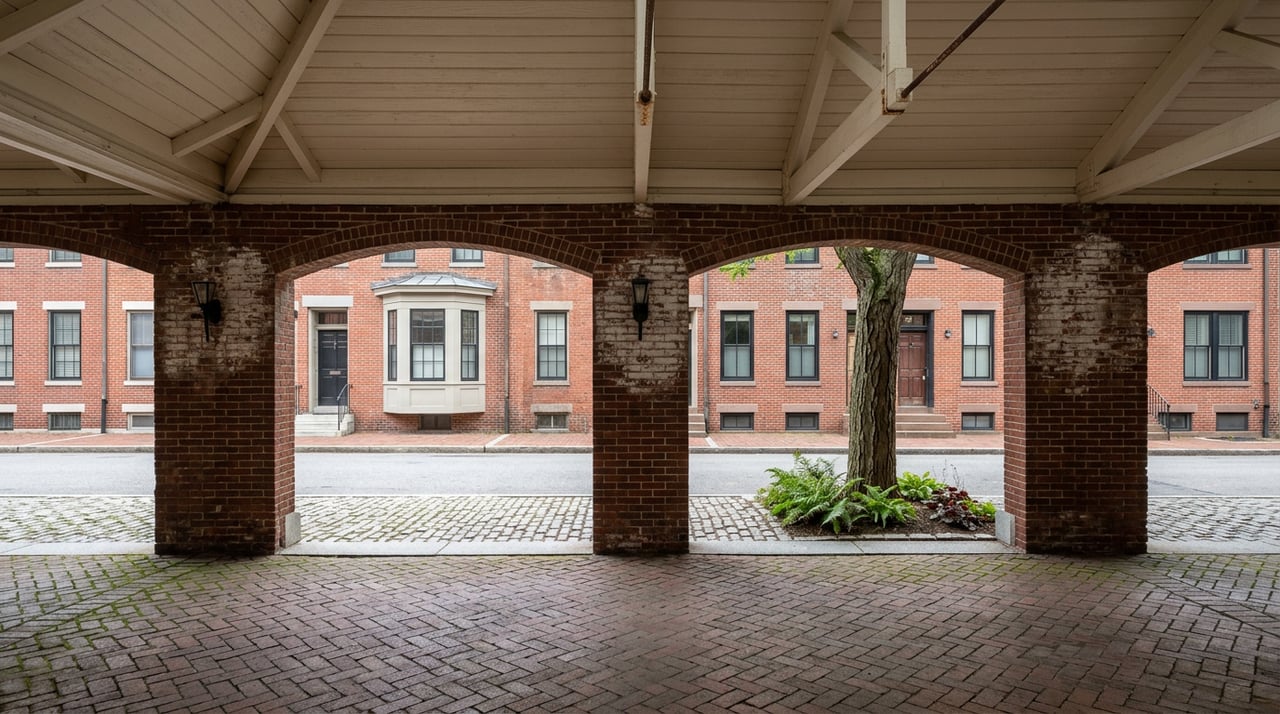
Anyone who has walked past 2nd and Pine this year has seen it: sections of construction fencing wrapped around the Shambles, the covered brick colonnade that has anchored Head House Square since before the United States existed. The instinct is to assume the worst, that the old market building is finally giving out. It isn't. What's happening behind that fencing is the first real investment this landmark has seen in more than three decades, and it's arriving in the same year that a handful of other corners of Queen Village are also mid-change. None of it is coordinated. All of it is happening at once, on the same four or five blocks.
The market at 2nd Street between Pine and Lombard dates to 1745, built to relieve pressure on the city's original market on what's now Market Street. It was named a National Historic Landmark in 1966 and last saw a full restoration in 1994, led by the Head House Conservancy. That's the baseline worth holding onto: this is the first time in more than 30 years anyone has put real money into the structure itself.
The current work, reported by the Philadelphia Inquirer in May, is the first phase of a $1.5 million restoration covering deteriorating brickwork, the roof, the windows, and the cupola. The plans came from John Milner Architects, a firm with a national reputation in historic preservation, working with the New Market and Head House Conservancy, the nonprofit now responsible for the site. The initial scope also includes a new head house office, a ground-floor bathroom, and the restoration of the building's historic Isaiah Lukens clock. None of that is cosmetic. It's the kind of unglamorous structural work that has to happen before anyone talks about lighting or landscaping.
Here's the part that explains why this might still look unfinished a year from now. The $1.5 million came from the city, and it was enough to fund what conservancy board member Paul Levy calls the basic preservation of the building. It was not enough to fund everything the conservancy wants done.
"The $1.5 million that we got from the city is huge and important, and it's enabled us to do the basic preservation of the building. But it does not cover everything that needs to be done."
That's Levy, quoted in the same Inquirer report. The extras he's referring to, new lighting, repaired walkways, a brighter overall look, depend on private donors who haven't fully materialized yet. So the honest answer to "when will this be done" is: the structural bones will be sound soon, but the finished version of Head House Square is still waiting on a fundraising campaign that's running in parallel with the construction itself. If you're wondering why the timeline feels vague, that's why.
The timing isn't random either. City officials and preservation advocates have been explicit that they want this work visible in time for the country's 250th anniversary in 2026, the Semiquincentennial that Philadelphia has spent years preparing to host. A 281-year-old market getting a facelift the same year the city throws its biggest historical spotlight on itself is not a coincidence, it's the plan.
One detail matters more to daily life than any of the architectural specifics: the fencing only partially surrounds the site, and the Sunday market has kept operating through it. The Headhouse Farmers Market, run by The Food Trust since 2007, still sets up under the Shambles most Sundays with close to 50 rotating vendors, one of the larger farmers markets the organization runs anywhere in the city. The market itself is younger than the building by 262 years, but it's become the thing most residents actually associate with the site. Construction hasn't paused that rhythm. It's happening around it.
Walk two blocks off the square to South 4th Street and a different kind of change is underway, one that has nothing to do with city grants or historic preservation boards. Fabric Row, the strip between Bainbridge and Catharine that was once the commercial heart of Philadelphia's Jewish textile trade, is filling in with vintage boutiques, handmade jewelry sellers, and resale shops alongside the fabric merchants who remain.
This shift has been building for a while, but reporting from the Philadelphia Inquirer, summarized by Philadelphia.today in June, captured something that goes beyond storefront turnover. Emily Hawkins, who manages Moon+Arrow on the block, described the corridor's evolving character directly: "There's a sense of community that has grown more each year I've worked on this street." Shop owners along the row have started promoting each other rather than competing block by block, which is a different mechanism than what's driving the market restoration but produces a similar result. Two very different institutions, one funded top-down and one growing shop by shop, are both visibly in motion in 2026.
The clearest evidence that people are still betting on this stretch of Queen Village might be the fact that empty storefronts aren't staying empty for long. Two recent openings sit almost directly across the street from each other on South 6th:
Both spaces had established restaurants in them before. Neither sat vacant long enough to become a talking point. That's a small detail, but in a commercial corridor, storefronts that turn over quickly instead of sitting dark for a year say something real about demand.
None of these four things, the market restoration, the farmers market's unbroken schedule, Fabric Row's slow reinvention, or two restaurants swapping into occupied space, happened because anyone planned them together. That's actually the point. When several unrelated parts of a small neighborhood are all mid-change in the same calendar year, without any single entity coordinating it, that tends to reflect something more durable than a single grant or a single trendy opening. It reflects a place enough people and institutions are willing to keep investing in, publicly and privately, all at once.
For residents, the practical takeaway is simple: the fencing at 2nd and Pine will probably be there for a while longer, the Sunday market isn't going anywhere, and it's worth walking down Fabric Row this fall to see which storefronts have changed hands since the last time you looked closely.
Evangeline Gambardella works these blocks closely enough to know that changes like these tend to show up in home values well before they show up in headlines. If you're curious what a restored Head House Square and a reinvented Fabric Row could mean for property values on these streets, get a free home valuation and start the conversation.
Stay up to date on the latest real estate trends.
Every client deserves to feel valued, heard, and supported. From our first conversation to the final handshake, my goal is to ensure your experience is as smooth and special as the moment. Your happiness isn’t just a priority—it’s the standard.

EVANGELINE GAMBARDELLA
728 S Broad St 3rd Fl Philadelphia PA 19146